
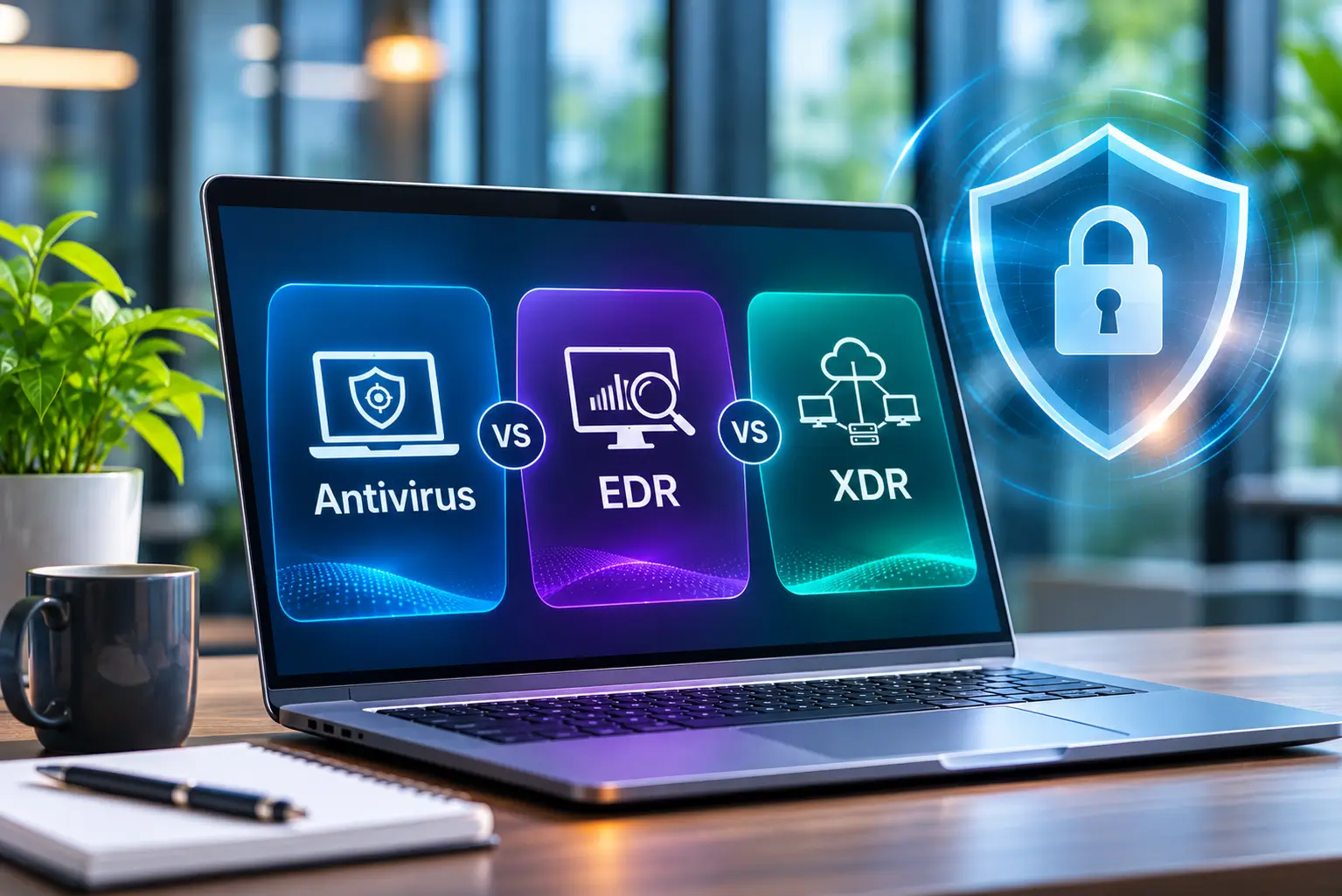
Antivirus, EDR and XDR are three generations of endpoint protection. Antivirus blocks known malware by matching signatures. EDR, endpoint detection and response, watches endpoint behavior to catch and respond to threats that have no signature. XDR, extended detection and response, correlates signals across endpoints, identity, email, cloud and network for a fuller picture. Modern attacks need more than antivirus alone.
What antivirus does, and its limits
Traditional antivirus scans files and matches them against a database of known malware signatures. It is fast, cheap and still useful for stopping commodity malware. Its weakness is everything it has never seen: novel malware, fileless attacks that run in memory, and legitimate tools misused by attackers. If a threat has no signature, signature-based antivirus is blind to it.
What is EDR?
Endpoint detection and response (EDR) moves from matching signatures to watching behavior. It records what happens on each endpoint, processes, network connections, file changes, and flags patterns that look like an attack, even with no known signature. Crucially, it adds response: analysts can isolate a device, kill a process or roll back changes from a central console. See Billow’s endpoint security services.
What is XDR?
Extended detection and response (XDR) widens the lens beyond the endpoint. It brings together signals from endpoints, identity, email, cloud and network, and correlates them so a quiet alert in one place plus a quiet alert in another add up to a detected attack. That cross-domain view shortens investigation and catches threats that move between systems, the way real attackers do.
EDR vs XDR vs antivirus: a comparison
| Capability | Antivirus | EDR | XDR |
|---|---|---|---|
| Detects | Known malware (signatures) | Suspicious endpoint behavior | Correlated threats across domains |
| Catches novel/fileless attacks | No | Yes | Yes |
| Scope | Single endpoint | Endpoints | Endpoints, identity, email, cloud, network |
| Response actions | Block/quarantine | Isolate, kill, roll back | Coordinated across domains |
| Needs monitoring/people | Minimal | Yes | Yes |
| Best for | Baseline hygiene | Most businesses | Broader, correlated visibility |
Which do you need?
Antivirus is a baseline, not a strategy. Most organizations today need at least EDR, because the attacks that cause real damage, ransomware, credential theft, hands-on intrusions, are exactly the ones antivirus misses. XDR makes sense when you have multiple signal sources (identity, email, cloud) and want them correlated rather than watched in silos. Pairing endpoint protection with threat intelligence and protection sharpens detection further.
Tools are not enough: detection needs response
EDR and XDR generate alerts; someone has to triage and act on them, often around the clock. Without monitoring, strong tools still miss real attacks simply because no one responded in time. Many organizations close this gap with a managed service or a SIEM and SOAR capability that centralizes alerts and automates response.
How Billow helps
Billow deploys and runs modern endpoint security, EDR and XDR, and backs it with monitoring, threat protection and SIEM and SOAR so detections lead to fast response. If you are not sure your endpoints are truly covered, our cybersecurity team can assess it.
Frequently asked questions
Is antivirus still necessary?
Antivirus still has a place as basic hygiene against commodity malware, and EDR and XDR platforms usually include that signature-based blocking. On its own, though, antivirus is not enough, because it misses novel, fileless and hands-on attacks that have no signature.
What is the difference between EDR and XDR?
EDR focuses on endpoints: it detects and responds to threats on laptops, servers and devices. XDR extends that detection across endpoints plus identity, email, cloud and network, and correlates the signals, giving a broader, connected view of an attack.
Do I need both EDR and antivirus?
In practice you get both together. Modern EDR and XDR platforms include signature-based antivirus and add behavioral detection and response on top, so you do not run a separate legacy antivirus alongside them.
Is XDR worth it for a small business?
It depends on your environment. If you have several signal sources such as cloud, email and identity, XDR’s correlation is valuable. Many smaller businesses start with EDR delivered as a managed service, then move to XDR as their estate grows.
Does EDR require a security team?
EDR produces alerts and response actions that someone needs to monitor and act on, ideally around the clock. Organizations without an in-house team usually get this through a managed detection and response service, so the tool actually leads to a response.