
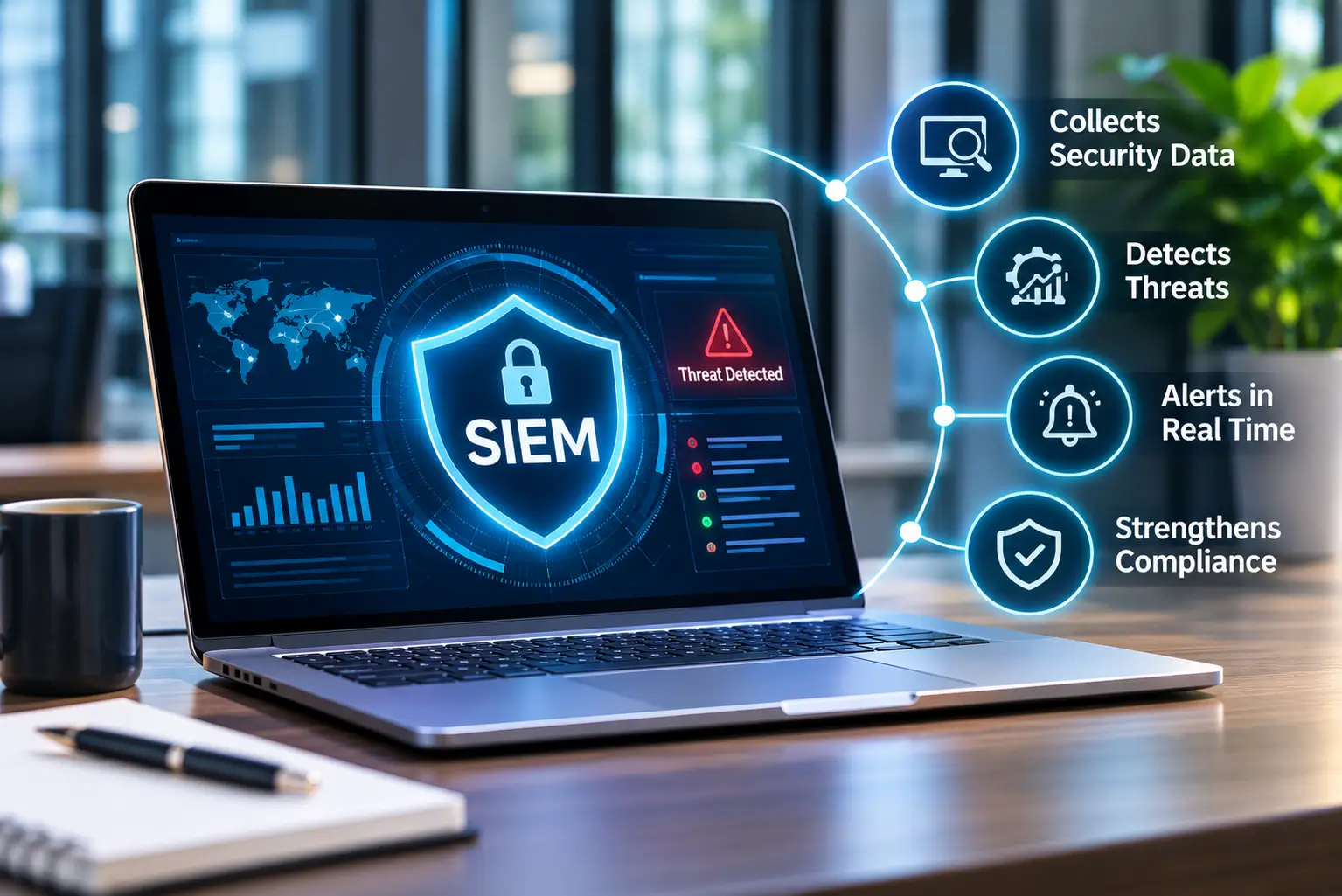
A SIEM, security information and event management, platform collects logs and security events from across your environment, correlates them, and alerts on signs of an attack. It gives you central visibility, faster detection and an audit trail for compliance. Not every business needs to run one in-house, but most benefit from SIEM capability, increasingly delivered as a managed service paired with SOAR for automated response.
What is SIEM?
SIEM software gathers log and event data from across your systems, servers, endpoints, firewalls, identity providers, cloud services, into one place. It normalizes that data, correlates events across sources, and raises alerts when the combined picture looks like a threat. In short, it is the central nervous system for security monitoring: the place where scattered signals become a detectable attack.
What does a SIEM do?
- Collects logs and events from across the environment into one store.
- Correlates activity across sources, so related events become a single alert.
- Detects and alerts on patterns that indicate an attack, in near real time.
- Supports investigation with searchable history and context for analysts.
- Reports for compliance, giving auditors the evidence and retention they require.
SIEM vs SOAR
SIEM and SOAR are complementary. SIEM detects; SOAR responds. SOAR, security orchestration, automation and response, takes the alerts a SIEM produces and runs automated playbooks: enrich the alert, open a ticket, isolate a device, block an address. Together they shorten the time from detection to containment.
| SIEM | SOAR | |
|---|---|---|
| Primary job | Detect and alert | Respond and automate |
| Works on | Logs and events | Alerts and workflows |
| Output | Prioritized alerts | Automated actions, faster response |
| Value | Visibility and detection | Less manual effort, quicker containment |
Does your business need a SIEM?
You likely need SIEM capability if any of these are true: you have compliance obligations that require log retention and monitoring; you have grown to the point where manual log review is impractical; you have limited visibility into what is happening across your systems; or you have had incidents you detected late. Billow delivers this through SIEM and SOAR services, and maps it to frameworks via compliance and security audit support.
Specialized environments raise the bar further. If you run industrial or operational technology, monitoring needs to cover those systems too; see OT security.
Build, buy, or managed SIEM?
Running a SIEM yourself means licensing, tuning, and a team to watch it around the clock, which is a significant commitment. Many organizations instead buy it as a managed service, where a provider runs the platform, tunes the rules, and monitors alerts, often adding threat intelligence so detections reflect current attacker behavior. That gives you the capability without building a 24/7 operation from scratch.
How Billow helps
Billow provides SIEM and SOAR as a managed capability: we deploy and tune the platform, monitor and respond, and produce the reporting your auditors expect. Combined with threat protection and compliance support, it gives you detection and response without standing up your own security operations center. Talk to our cybersecurity team to scope it.
Frequently asked questions
What does SIEM stand for and do?
SIEM stands for security information and event management. It collects logs and security events from across your systems, correlates them, and alerts on signs of an attack, giving central visibility, faster detection, and the audit trail that compliance requires.
What is the difference between SIEM and SOAR?
SIEM detects: it gathers and correlates events and raises alerts. SOAR responds: it takes those alerts and runs automated playbooks, such as enriching the alert, isolating a device or blocking an address. Used together, they cut the time from detection to containment.
Does a small business need a SIEM?
Many do, especially with compliance obligations or limited visibility, but running one in-house is often too much. Smaller businesses usually get SIEM capability through a managed service, which provides the detection and reporting without the cost of a full in-house operation.
Is a managed SIEM better than running your own?
For most organizations, yes. A managed SIEM gives you a tuned platform and around-the-clock monitoring without hiring and retaining a full security team. Running your own makes sense mainly for larger organizations with the scale and staff to operate it well.
How does SIEM help with compliance?
A SIEM retains logs, monitors activity, and produces reports that demonstrate you are watching for and responding to threats. That evidence and log retention is exactly what many frameworks, such as PCI DSS, HIPAA and SOC 2, require during an audit.